A Simple Guide to Living and Working in Dubai Without an Employer Sponsor
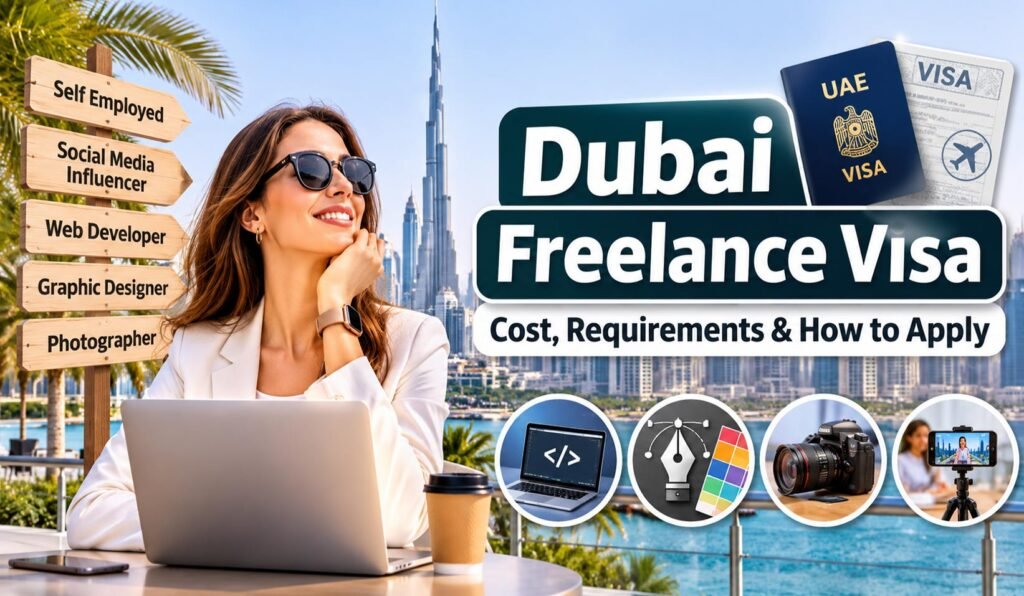
More people are quitting the 9 to 5 and building their own careers in Dubai, and the Dubai freelance visa is what makes that move legal. It lets you live in the UAE and work for yourself, without a company holding your visa. Dubai has no personal income tax, a fast-growing digital economy and clients from all over the world, so freelancing here makes sense for designers, developers, writers, marketers, trainers and many other professionals. If you are tired of depending on one employer, or you are new to the market and exploring the best Dubai jobs for freshers, this guide shows what the visa costs, who can get it and how to apply step by step.
Quick answer: A Dubai freelance visa is a residence visa tied to a freelance permit from a free zone. In 2026, the first year usually costs between AED 12,000 and AED 20,000. The permit is issued for one year and the residence visa is commonly valid for two years.
What Is a Dubai Freelance Visa?
Definition of a Freelance Visa
A Dubai freelance visa lets a skilled professional live in the UAE and work independently for one or many clients. You do not need an employer to sponsor you. Instead, you sponsor yourself through a free zone authority.
Here is a detail that confuses many people. The government does not issue one single product called a “freelance visa.” The term usually means two things working together: a freelance permit, which gives you the right to work for yourself, and a residence visa, which gives you the right to live in the country.
How It Differs From Employment and Business Visas
An employment visa is tied to one company. If you leave the job, the visa is cancelled. A business visa comes with a full trade licence, an office or desk, and often a larger budget. A Dubai freelance visa sits in the middle. It costs far less than setting up a company, and it is not linked to any single employer.
The trade-off is scope. A freelance permit covers only the activities listed on it, and you usually work as an individual, not as a company with staff.
Who Can Work Under a Freelance Visa?
The visa is meant for skilled professionals who sell their own services. Typical examples include designers, developers, writers, photographers, consultants and trainers. It is not meant for people who want to run a shop, hire a team or trade goods. Those plans need a company licence.
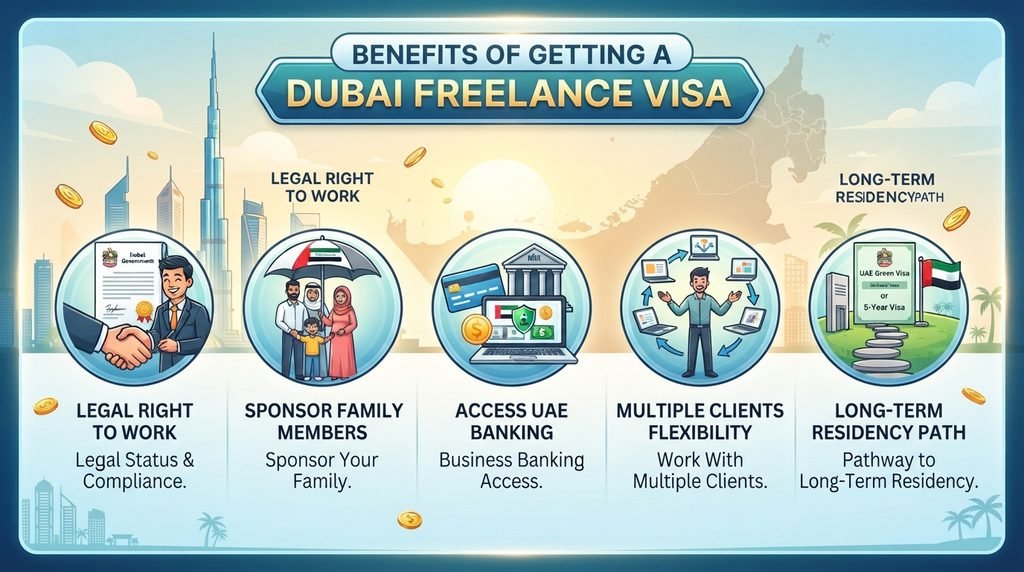
Benefits of Getting a Dubai Freelance Visa
Legal Right to Work Independently
Without a permit, taking paid work in the UAE can lead to fines and trouble with your residency. A permit gives you a legal footing, so you can sign contracts, send invoices and build a track record without worry.
Sponsoring Family Members
Once you hold a residence visa, you can usually apply to sponsor your spouse and children. Authorities normally ask for proof of income, often around AED 4,000 a month, or AED 3,000 with accommodation. You will also need a valid tenancy contract. Rules can change, so confirm the latest figures before you apply.
Access to UAE Banking Services
A residence visa and Emirates ID open the door to personal accounts, credit cards and loans. If you want to understand how online accounts work, our guide to digital banking in the UAE explains the options in plain terms.
Flexibility to Work With Multiple Clients
You are free to take on several clients at once. That spreads your risk. If one client leaves, your whole income does not disappear overnight.
Pathway to Long-Term UAE Residency
A freelance permit can also be a stepping stone to the five-year Green Visa for self-employed professionals. That visa has a minimum income rule, which has been around AED 360,000 a year, so check the current requirement before you plan around it.
Who Is Eligible for a Dubai Freelance Visa?
UAE Residents
If you already live in the UAE on an employment or family visa, you can apply for a freelance permit and transfer your residency. If you are still under an employment contract, settle your notice period and cancellation first. Your old visa has to be cancelled or transferred before the new one can be issued.
Foreign Nationals Applying From Abroad
You can also apply from outside the country. The free zone issues the permit, then you receive an entry permit, fly to Dubai, complete your medical test and Emirates ID, and get your visa stamped.
Required Qualifications and Experience
Most free zones want proof that you are skilled in your field. That can mean a degree, a diploma or several years of work experience. A strong portfolio often matters more than a certificate, especially in creative and digital fields.
Popular Professional Categories
Free zones usually issue freelance permits for specific sectors. The most common ones are:
- Media: journalists, photographers, videographers, voice artists and editors
- Technology: web and app developers, software testers, data specialists and IT consultants
- Education: tutors, trainers, coaches and curriculum developers
- Marketing and Design: brand strategists, graphic designers, UI and UX designers and advertising specialists
- Content Creation: writers, bloggers, podcasters, social media creators and translators
Dubai Freelance Visa Requirements
The exact list changes slightly between free zones, but most ask for the same core documents.
Valid Passport
Your passport should be valid for at least six months. Send a clear colour scan of the photo page.
Passport-Sized Photograph
Use a recent photo with a white background. Free zones are strict about size and quality, and a poor photo can delay your file.
CV or Resume
Keep it short and focused on your freelance field. Highlight clients, results and the tools you use.
Educational Certificates
Some zones ask for attested degree certificates, and some accept a diploma or proof of experience. Attestation can take a few days to a few weeks, so start early if you need it.
Portfolio or Previous Work Samples
This is where you prove your skill. Share live links, case studies, published articles or project screenshots that match the activity on your permit.
Freelance Permit Documentation
The permit itself is the document that allows you to work. Once the free zone approves your application, you will receive the permit and use it for the next steps, including your visa and Emirates ID.
How to Apply for a Dubai Freelance Visa
Choose a Freelance-Friendly Free Zone
Start by picking a free zone that covers your type of work. Compare the permit price, visa length and the activities allowed. Availability also changes, so ask the free zone directly whether it is accepting new individual freelancers right now.
Apply for a Freelance Permit
Submit your application online, choose your activity and pay the permit fee. Approval usually takes a few working days if your documents are complete.
Submit Required Documents
Upload your passport, photo, CV, certificates and portfolio. Double check every name and date, because small spelling mistakes are one of the most common reasons for delays.
Obtain Entry Permit (If Applicable)
If you are outside the UAE, the free zone will arrange an entry permit so you can fly in legally. If you are already in the country, you can skip this step.
Complete Medical Test and Emirates ID Registration
You must pass a standard medical test, which includes a blood test and a chest X-ray. After that, you register your biometrics for your Emirates ID.
Receive Your Residence Visa
Once everything clears, your visa is stamped or issued digitally and your Emirates ID is delivered. The full process commonly takes about two to four weeks.
Dubai Freelance Visa Cost Breakdown
The total depends on the free zone, the visa length and whether you apply from inside or outside the UAE. Most guides put the first-year cost of a Dubai freelance visa between AED 12,000 and AED 20,000. Renewal in later years is usually lower, around AED 7,500 to AED 10,000.
Freelance Permit Fees
Under the Dubai Development Authority’s GoFreelance programme, the published permit fee is AED 7,500, plus two small fees of AED 10 each for the Knowledge Dirham and Innovation Dirham. That makes AED 7,520 in total. Other free zones charge anywhere from about AED 5,500 to AED 15,000 or more.
Residence Visa Fees
Residence visa costs usually fall between AED 3,000 and AED 5,000, depending on the length and the free zone. One published GoFreelance breakdown lists a two-year visa at around AED 5,042. Remember that the permit renews every year, even if your visa lasts two.
Emirates ID Costs
Expect roughly AED 100 for each year of validity, plus a small service charge. For a two-year ID, the total is normally a few hundred dirhams.
Medical Examination Charges
A standard residency medical test typically costs between AED 300 and AED 400 at an approved centre.
Additional Administrative Fees
Many people forget the smaller costs. These can include an establishment card of about AED 2,000, typing and processing fees of AED 150 to AED 1,000, health insurance, and a desk or PO Box if the zone requires one. Adding these up, a realistic first-year budget for many freelancers is close to AED 15,000 to AED 22,000.
Best Free Zones Offering Freelance Visas in Dubai
Prices and availability change often, and some advisers reported in early 2026 that a few older Dubai zones had restricted new individual permits. Always confirm the current status with the free zone before you pay.
GoFreelance
GoFreelance is the Dubai Development Authority’s programme for independent professionals. It is one of the most talked-about routes because of its clear pricing and its focus on media, technology and creative work.
Dubai Media City
This is the home of broadcasters, publishers and creative agencies. It suits journalists, video producers, photographers and content creators who want to be around other media professionals.
Dubai Internet City
The region’s tech hub, home to many global software and internet companies. It works well for developers, IT consultants and digital specialists.
Dubai Knowledge Park
Built for education and training. Tutors, coaches, corporate trainers and learning designers often look at this zone first.
Dubai Design District (d3)
A creative community for designers, fashion professionals, artists and brand specialists. If your work is visual, it is worth checking what d3 offers for independent creators.
What Jobs Can You Do on a Dubai Freelance Visa?
Digital Marketing Specialist
Businesses in Dubai constantly need help with search ads, social campaigns and email marketing. Freelancers who can show real results often find steady work.
Graphic Designer
Logos, brochures, packaging and social media graphics are always in demand, especially from small and medium companies.
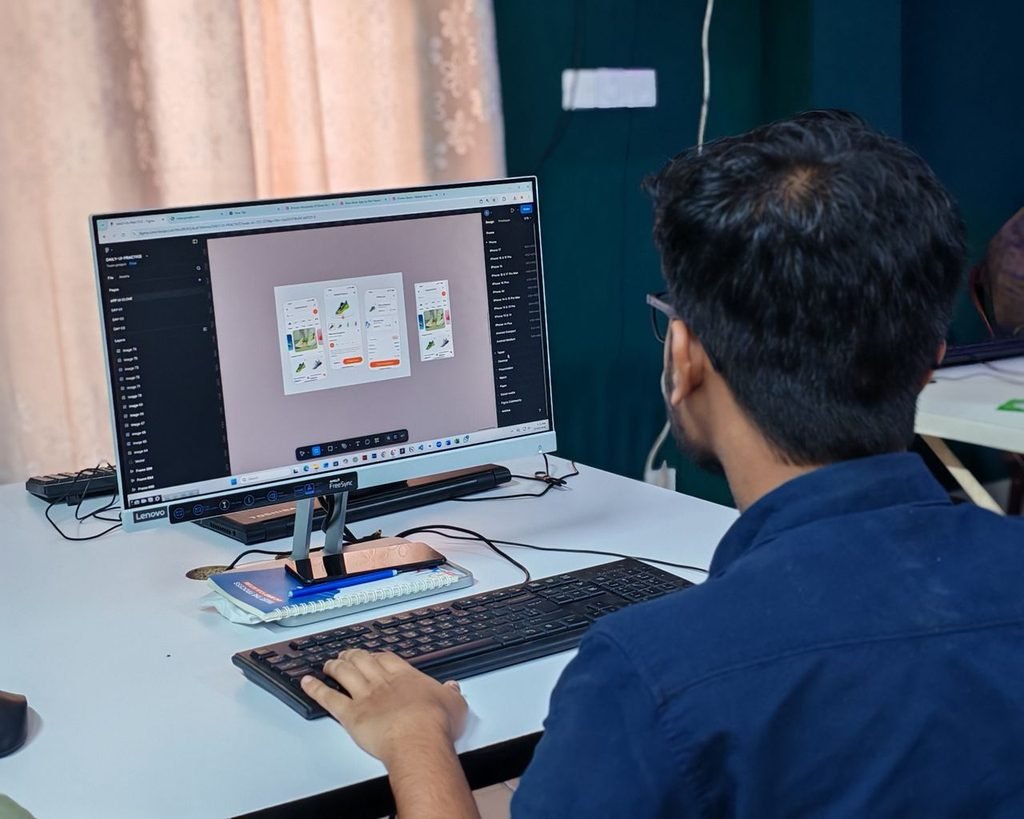
Web Developer
From simple business websites to online stores, developers are among the most in-demand freelancers in the city.
Content Writer
Companies need blog posts, website copy, product descriptions and reports in English and Arabic. Strong writers with a niche, such as finance or real estate, can charge more.
Photographer and Videographer
Hotels, restaurants, real estate firms and brands hire visual creators all year. Note that some shoots in public places need separate filming permission.
Social Media Manager
Many businesses prefer to hire a freelancer rather than a full-time employee to run their accounts.
Consultant and Trainer
Experienced professionals can sell their knowledge through workshops and advisory work. Those with a corporate background, such as finance specialists, often do well here. If you come from that world, you may also like our guide to accountant jobs in Dubai to compare freelance income with full-time pay.
Can Freelancers Open a Bank Account in Dubai?
Yes, freelancers can open a personal bank account in Dubai, and some banks also offer accounts for self-employed people. Approval is usually easier once your visa and Emirates ID are ready.
Banking Requirements
Banks normally ask for your passport, residence visa, Emirates ID and freelance permit. Some set a minimum balance, which can range from around AED 3,000 to AED 25,000 depending on the bank and the account type.
Documents Banks May Request
Be ready with these:
- Proof of address or tenancy contract
- Recent bank statements, often three to six months
- Client contracts or invoices
- A letter or proof showing your expected income
Tips for Approval
Keep your documents consistent, show regular client income, and apply to a bank that already works with freelancers. Digital banks can be quicker, so look at several options before you decide.
Tax and Financial Considerations for Freelancers in Dubai
Personal Income Tax in the UAE
The UAE does not charge personal income tax on salary or freelance earnings. That is a big reason many professionals move here.
Corporate Tax Considerations
The UAE has a 9% corporate tax on taxable profit above AED 375,000. For individuals, it applies when business turnover goes above AED 1 million in a calendar year. Most new freelancers will earn less than that, but you should track your revenue carefully. VAT is a separate matter. You must register if your taxable supplies pass AED 375,000 a year.
Record-Keeping Best Practices
Save every invoice, receipt and contract. Use a separate bank account for work. Keep records for at least five years, which is what UAE rules generally require.
Invoicing Clients Professionally
A good invoice includes your name and permit number, the client’s details, a clear description of the work, the amount, the due date and payment details. Professional invoices get paid faster and protect you in a dispute.
Dubai Freelance Visa vs Employment Visa
Key Differences
With an employment visa, your company sponsors you and handles the paperwork. With a Dubai freelance visa, you sponsor yourself, pay your own fees and find your own work.
Advantages and Disadvantages
The freelance route gives you freedom, multiple income streams and a business of your own. The downsides are uncertain income, no employer benefits such as paid leave or end-of-service pay, and the need to manage your own paperwork and health insurance.
Which Option Is Right for You?
Choose a freelance visa if you have proven skills, savings to cover a few slow months and a few clients lined up. Stick with employment if you want a steady salary or you are just starting your career. You can browse current openings in our jobs in Dubai section before you decide.
Common Challenges Freelancers Face in Dubai
Finding Consistent Clients
Income can swing from month to month. Build a base of two or three regular clients, and keep looking for new ones even when you are busy.
Managing Visa Renewals
The permit renews yearly and the visa follows its own timeline. Put both dates in your calendar so nothing slips.
Understanding Compliance Requirements
Rules around permits, tax and activity limits can change. Check updates from your free zone, and speak with an accountant if you are unsure.
Building Professional Networks
Most freelance work in Dubai comes through people. Join industry events, co-working spaces and online communities, and ask happy clients for referrals.
How to Renew a Dubai Freelance Visa
Renewal Timeline
Start the process about 30 days before your permit expires. Renewing early leaves time to fix any issues.
Required Documents
You will usually need your current permit, passport, Emirates ID, a recent photo and proof of health insurance. Some zones may ask for an updated portfolio.
Renewal Fees
The permit fee is paid every year, so budget again for something close to the original amount, often AED 7,500 or more. If your visa also expires, add the residence visa and Emirates ID costs.
Common Renewal Mistakes to Avoid
- Waiting until the last week to apply
- Forgetting that the permit and visa expire on different dates
- Letting health insurance lapse
- Ignoring late fines, which can build up daily
Conclusion
A Dubai freelance visa gives you the legal right to work for yourself, sponsor your family, open bank accounts and build a long-term life in the UAE. It costs far less than a full company licence, and it gives you the freedom to choose your own clients. It is best for skilled professionals in media, technology, education, marketing, design and content creation.
Before you apply, check the current fees, confirm that your chosen free zone is accepting new freelancers, and make sure you have savings to cover the first few months. Plan for the yearly permit renewal as well, since it is the cost people forget most often. With the right preparation, freelancing in Dubai can become a stable and rewarding career.
Frequently Asked Questions About Dubai Freelance Visa
Can I work for multiple clients?
Yes. A Dubai freelance visa allows you to work with several clients at the same time, as long as the work matches the activity listed on your freelance permit.
Can I sponsor my spouse and children?
Yes, in most cases. Once you hold a residence visa, you can apply to sponsor your family if you meet the income and housing requirements. These usually include proof of around AED 4,000 a month, or AED 3,000 with accommodation, and a tenancy contract.
Can I apply while outside the UAE?
Yes. Many free zones accept applications from abroad. After approval, you receive an entry permit, travel to Dubai, complete your medical test and Emirates ID, and then get your residence visa.
How long is a freelance visa valid?
The freelance permit is valid for one year and must be renewed annually. The residence visa is commonly valid for two years, though some routes offer different lengths. The Green Visa for self-employed professionals lasts five years.
Can I switch from an employment visa to a freelance visa?
Yes. You need to cancel or transfer your current employment visa, and you may need clearance from your employer if you are still under contract. After that, the free zone can issue your freelance permit and new visa.
Is a freelance visa the same as a freelance permit?
No. The permit gives you the right to work as a freelancer, while the visa gives you the right to live in the UAE. In practice, you need both, so most free zones offer them together in one package.

Ahmad Yusuf is a professional content writer with experience creating engaging, well-researched content across lifestyle, travel, and business topics. With a strong understanding of Dubai’s dynamic culture and experiences, he currently writes for Dubai Unfold, covering the city’s attractions, lifestyle, events, and evolving trends. His work combines clear storytelling with accurate information to help readers discover and experience Dubai.