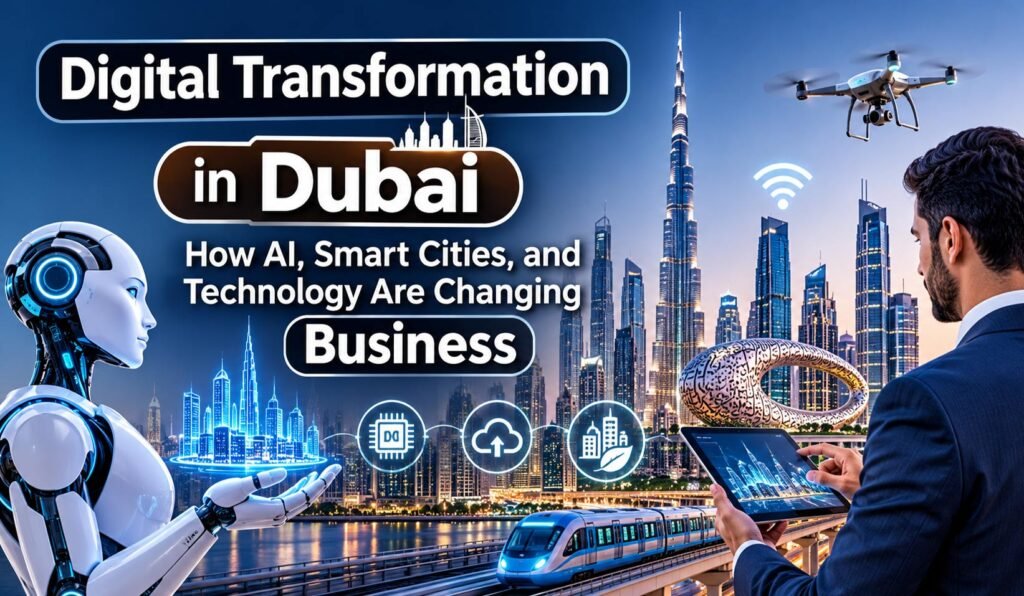
A clear guide to the technologies, government projects, and business changes shaping daily life and work in Dubai
Dubai built one of the world’s busiest airports and a giant port in just a few decades. Now it is doing the same with technology. Digital transformation in Dubai is changing how people renew a visa, pay a bill, see a doctor, and start a company, often in a few taps on a phone.
The city treats digital innovation as a core strategy, not a side project. The Dubai Economic Agenda, known as D33, aims to double the size of the economy by 2033, and it expects digital projects to add AED 100 billion to that economy every year. Government offices, banks, hospitals, shops, and logistics firms are all changing how they work to keep up.
This guide explains what digital transformation really means, what Dubai has already built, which industries gain the most, and which problems still need work. You will also find practical steps for any business that wants to start, and clear answers to common questions at the end.
What Is Digital Transformation?
Digital transformation means using technology to change how an organization works and serves people, not just moving old tasks online. Before looking at Dubai’s results, it helps to be clear on the basics.
Definition and Core Concepts
Digital transformation is the process of using digital tools to improve how an organization runs, makes decisions, and serves its customers. It rests on three parts: technology, processes, and people. A new app alone is not enough. The team also has to rebuild old workflows and learn to use the new system.
In simple terms, digital transformation in Dubai means a service that once needed a visit, a stack of papers, and a long wait now runs online, often in minutes. The core ideas are putting the customer first, using data to make choices, automating repeat work, and improving all the time.
Key Technologies Driving Transformation
Six technologies do most of the heavy lifting in Dubai right now:
- Artificial Intelligence (AI): Software that learns from data to answer questions, spot patterns, and make predictions. Dubai uses it in customer chatbots, traffic control, and city planning.
- Cloud Computing: Renting computing power and storage over the internet instead of owning servers. It lets organizations handle busy periods, such as visa renewals or big events, without buying extra hardware.
- Big Data Analytics: Studying large sets of information to find useful trends. Dubai Pulse, the city’s open data platform, shares data from many government bodies for this purpose.
- Internet of Things (IoT): Sensors and connected devices that collect real-time information. Dubai Electricity and Water Authority (DEWA) uses smart meters to track power and water use.
- Blockchain: A shared record that is very hard to change. The Dubai Land Department has used it for digital rental contracts, and the Department of Economy used it for customer identity checks.
- Automation and Robotics: Machines and software that handle repeat tasks. Dubai Police use patrol robots and drones, and the Dubai Metro runs without drivers.

Digital Transformation vs Digitalization
People often mix these two terms, but they are not the same. Digitalization means turning something paper-based into a digital format. Digital transformation means redesigning the whole service around digital tools.
| Digitalization | Digital Transformation | |
|---|---|---|
| Main goal | Replace paper with digital files | Change how the whole service works |
| Example | Scanning a licence form and emailing it | Applying, paying, and receiving the licence in one online journey |
| Scope | One task or document | Whole process, culture, and technology |
| Result | Small time savings | Lower cost, faster service, better experience |
Dubai started with digitalization and then went further. Once forms were online, the government removed the extra steps behind them.
Why Dubai Is Leading Digital Transformation in the Middle East
Dubai leads the region because a clear vision, steady funding, and flexible rules all work together. Each of these pieces supports the others.
Dubai’s Vision for a Digital Future
The plan began in 2014, when Sheikh Mohammed bin Rashid Al Maktoum launched the Smart Dubai initiative with the goal of making Dubai the happiest and smartest city in the world. In January 2023, he announced D33, a ten-year agenda to double the economy to about AED 32 trillion by 2033 and place Dubai among the top three global cities.
Digital projects sit at the center of D33. The agenda expects them to bring in AED 100 billion every year. To see where these goals may lead, read our guide on Dubai’s future technology and innovation.
Government-Led Innovation Strategies
In Dubai, the government acts as the first customer for new technology. It sets targets, passes laws that make digital services legal, and then moves its own departments online first. The Dubai Blockchain Strategy started in 2016, the Dubai Data Law in 2015 allowed organized data sharing, and the Dubai Future Foundation, set up in 2016, tests new ideas through labs and accelerators.
In 2019, Dubai also released AI ethics guidelines, which gave companies clear rules on fair and safe AI use. When rules arrive early, businesses feel safer investing.
Investment in Smart Infrastructure
Technology needs strong foundations, and Dubai has spent heavily on them. The Dubai Metro, which opened in 2009, runs without drivers. Jebel Ali port and Dubai International Airport handle huge volumes of cargo and passengers. Fibre internet and 5G networks cover much of the city.
Dubai has also announced plans for AI-focused data centres that it expects to add around USD 3.89 billion in economic growth by 2028. Data centres matter because AI tools, cloud services, and online government platforms all depend on them.
Business-Friendly Regulatory Environment
Companies move to Dubai partly because the rules are easy to work with. Free zones such as Dubai Internet City, Dubai Silicon Oasis, and DIFC offer ready-made setups for tech firms. Since 2021, most business activities outside free zones can have full foreign ownership. The Virtual Working Programme, launched in 2020, lets remote workers live in Dubai on a one-year visa.
The D33 plan also aims to lift foreign direct investment from an average of AED 32 billion a year to about AED 60 billion a year over the next decade. That target shows how much the city wants global tech companies to settle here.
Key Digital Transformation Initiatives in Dubai
Dubai has not relied on one big project. It has launched several linked programs, and each one adds to the others.
Dubai Smart City Initiative
The Dubai Smart City Initiative began in 2014 and spreads across six areas: smart economy, smart governance, smart living, smart mobility, smart environment, and smart people. The goal is to make life easier by joining services, data, and infrastructure in one connected system.
Smart Dubai was the body that drove this work. It has since become Digital Dubai, the authority that now leads the city’s digital agenda.
Dubai Digital Strategy
The Dubai Digital Strategy is the roadmap that ties government services, AI, data, and cyber safety together. It focuses on end-to-end digital government, strong data and AI rules, and citywide cyber resilience. It also supports D33 by helping Dubai become a leading digital economy.
Think of it as the plan that keeps every department moving in the same direction, so a resident does not face a different system at each office.
Paperless Government Program
This program may be the clearest proof of digital transformation in Dubai. Launched in 2018, the Dubai Paperless Strategy rolled out in five phases across 45 government entities. Those entities now offer more than 1,800 digital services and 10,500 key transactions.
In late 2021, Dubai announced that it had become the world’s first fully paperless government. Officials reported savings of more than AED 1.3 billion, over 14 million working hours, and more than 336 million sheets of paper.
Smart Dubai Projects
Several Smart Dubai projects now touch daily life. The DubaiNow app gives access to more than 130 services in 12 categories, such as bills, traffic fines, and housing. Dubai Pulse opens city data to researchers and companies. The blockchain program moved records like rental contracts to a secure shared ledger. The Dubai AI Ethics Guidelines set rules for building trusted AI.
Together these projects turned a big vision into tools people can open on their phones.
AI Strategy and Future Foundation
The UAE appointed the world’s first Minister of State for Artificial Intelligence in 2017, and Dubai has followed with its own plans. The Dubai Universal Blueprint for Artificial Intelligence, launched by Sheikh Hamdan bin Mohammed, aims to help add AED 100 billion to the economy and lift productivity by 50 percent.
The Dubai Future Foundation backs this work. It runs the Museum of the Future and the Dubai Future Accelerators, which connect startups with government entities to test real solutions. If you want to see where AI is heading next, our article on agentic AI in Dubai explains how autonomous systems are starting to act on their own.
Digital Transformation in Dubai Government Services
Government services are where most residents notice the change first. A task that once took a day now often takes a few minutes.
Digital Government Platforms
Dubai residents now use a small set of platforms instead of visiting many counters. The official dubai.ae portal lists services from across the emirate, and the DubaiNow app covers day-to-day needs like paying utility bills, renewing a car registration, or checking traffic fines.
Behind these apps, 45 government entities have moved their work onto digital systems. That means the departments can pass information to each other, so you do not need to submit the same document twice.
UAE PASS and Digital Identity
UAE PASS is the national digital identity app, launched in 2018. It gives users one login for thousands of government and private services, and it lets them sign documents digitally and store verified records in a Digital Vault. By mid-2026, it had more than 12 million registered users, up from 11 million in 2025.
The platform handled around 1.5 million digital transactions a day in 2025. In July 2026, the World Economic Forum recognized UAE PASS as a global model for digital government. If you plan to apply for public sector roles, our guide to government jobs in Dubai shows how this digital system fits into the hiring process.
Online Licensing and Permits
Starting a business no longer needs a pile of papers. Entrepreneurs can apply for, renew, and pay for trade licences online through Dubai Economy and Tourism channels. Building permits, event permits, and many municipal approvals have also moved online.
For business owners, this cuts waiting time and reduces mistakes. It also makes the process easier to track, because every step leaves a digital record.
Smart Payment Systems
Paying the government is now simple. DubaiPay, the government’s e-payment system, lets people settle fees by card or online. Commuters use the Nol card and the Nol Pay app to travel on the metro, buses, and trams. Contactless and mobile wallet payments work in most shops.
The UAE Central Bank is also working on a digital Dirham, which would add another way to pay. For a closer look at how money moves online, read our guide to digital banking in the UAE.
Benefits for Residents and Businesses
The gains are easy to measure. The paperless program alone saved AED 1.3 billion and 14 million working hours. For residents, that means fewer trips, shorter queues, and services that work at any hour. For businesses, it means faster licences, clearer fees, and less time lost on paperwork.
Trust has grown too. When people can track a request online, they know where it stands and who handled it.
How Digital Transformation Is Changing Businesses in Dubai
The private sector is moving just as fast. Companies in Dubai now compete on speed, convenience, and smart use of data. Our list of the best AI tools for UAE businesses shows which tools many teams already use.
Digital-First Business Models
Many of Dubai’s best-known brands were built online from day one. Careem started in Dubai in 2012 as a ride-hailing app, and Uber bought it in 2019 for USD 3.1 billion. Noon, launched in 2017, became a major regional online marketplace.
These companies show that a digital-first model can grow quickly in the Gulf. Older companies are now copying the approach by adding apps, online ordering, and subscription services to what they already sell.
Automation and Operational Efficiency
Automation takes over boring, repeat work such as invoice entry, stock checks, and report writing. That frees staff to spend time on tasks that need judgment, like solving customer problems or planning growth.
Dubai’s public bodies lead by example. DEWA, for instance, introduced a virtual assistant named Rammas to answer customer questions around the clock. Private firms copy this by using bots for booking, billing, and support.
Customer Experience Enhancement
Customers in Dubai expect fast, simple service. They want to book on a phone, pay with one tap, and get an update on WhatsApp. Companies that meet these needs keep more customers.
Good digital service also works in more than one language. Many Dubai businesses now offer support in Arabic, English, and other languages used by the city’s residents, who come from more than 200 nationalities.
Data-Driven Decision Making
Data helps businesses stop guessing. A retailer can see which products sell best in each mall. A hotel can adjust room prices based on demand. A logistics firm can pick the fastest delivery route using live traffic data.
Open platforms like Dubai Pulse make this easier, because companies can use public data to study markets and plan better.
Remote and Hybrid Work Technologies
Dubai has made remote work a policy goal. The Virtual Working Programme gives remote workers a way to live in the city, and a UAE minister now holds a role that includes remote work applications. Video calls, cloud documents, and project boards keep teams connected across time zones.
For employers, this widens the hiring pool. For workers, it adds flexibility without giving up access to Dubai’s services and lifestyle.
Industry Sectors Benefiting from Digital Transformation
Every major industry in Dubai is changing, but some sectors show the shift more clearly than others.
Banking and Financial Services
Banks in Dubai now offer account opening, loans, and payments through apps. Digital-only banks such as Zand and Wio have joined traditional lenders, and DIFC hosts a growing group of fintech firms. Strong rules from the Central Bank and the Dubai Financial Services Authority help keep these services safe.
For more detail, see our digital banking guide for the UAE.
Healthcare and Telemedicine
The Dubai Health Authority supports electronic medical records through systems such as Salama and the NABIDH health information exchange, which lets approved doctors view a patient’s history with consent. A federal law passed in 2019 sets rules for using information and communication technology in healthcare, which covers telemedicine.
Patients can book appointments, talk to doctors by video, and receive prescriptions without waiting in a clinic.
Real Estate and PropTech
Dubai’s property market has gone digital at every step. Buyers browse listings and virtual tours online, and the Dubai Land Department offers digital services through its REST app. Blockchain has been used for rental contracts, and the city has tested tokenized property ownership in a pilot program.
These changes bring more transparency, which matters to foreign investors who want clear records.
Retail and E-Commerce
Online shopping is now part of normal life in Dubai. Platforms like Noon and Amazon.ae deliver fast, and food apps bring meals to the door in minutes. Physical stores respond with apps, loyalty programs, and click-and-collect services.
The winners are retailers that blend online and in-store shopping, so customers can start in one place and finish in another.
Logistics and Supply Chain
Dubai sits at a crossroads between Asia, Europe, and Africa, so logistics is central to its economy. DP World runs Jebel Ali, one of the region’s largest ports, and the Dubai Trade platform helps companies handle customs paperwork online.
Sensors, tracking software, and automated warehouses let companies follow a shipment from the factory to the customer’s door.
Tourism and Hospitality
Dubai welcomed about 18.7 million international overnight visitors in 2024, a record at that time. Digital tools help the city handle that volume. Biometric smart gates at the airport speed up passport checks, hotels use apps for check-in and room control, and travel platforms offer easy booking.
AI also helps hotels set prices and plan staff schedules based on expected demand.
Education and E-Learning
Schools and universities in Dubai use online classes, digital libraries, and learning apps. The UAE announced that AI will become part of the school curriculum from kindergarten through grade 12 starting in the 2025 to 2026 school year. The Dubai AI Campus in DIFC also aims to bring together AI companies, researchers, and learners.
This shift matters because the next wave of Dubai’s workforce will grow up using these tools every day.
Role of Artificial Intelligence in Dubai’s Digital Transformation
AI is the fastest-moving part of the story. The UAE government says the digital economy now adds close to 12 percent of national GDP, and it wants that share to pass 20 percent by 2031. AI is a big reason why.
Government AI Applications
Dubai’s government uses AI to answer questions, plan traffic, support police work, and manage energy and water. The 2019 AI ethics guidelines ask each project to be fair, clear, and safe, so people can trust what the system does.
The next step is software agents that can finish whole tasks, not just answer questions. Our piece on agentic AI in Dubai looks at how that shift could change public services.
AI in Business Operations
Companies in Dubai use AI to forecast demand, flag unusual payments, screen job applications, and plan delivery routes. A shop can predict which items will run low before a busy weekend. A bank can spot fraud within seconds.
The best results come when AI supports a clear goal, like cutting delivery time or lowering support costs. Buying AI without a goal usually wastes money.
AI-Powered Customer Service
Chatbots and voice assistants now handle simple questions at any hour, in Arabic, English, and other languages. DEWA’s virtual assistant Rammas is one example from the public sector, and many banks, airlines, and telecom firms run similar tools.
The smart way to use them is to let the bot handle simple requests and pass hard cases to a person quickly. Customers get fast answers, and staff get time for the cases that need care.
Predictive Analytics and Automation
Predictive analytics uses past data to guess what will happen next. Utilities can repair equipment before it breaks. Hotels can predict how many guests will arrive. Traffic teams can see where jams will form and change signals early.
When these predictions connect to automated actions, such as sending a repair crew or adjusting a price, work gets faster and cheaper.
Smart City Technologies Transforming Dubai
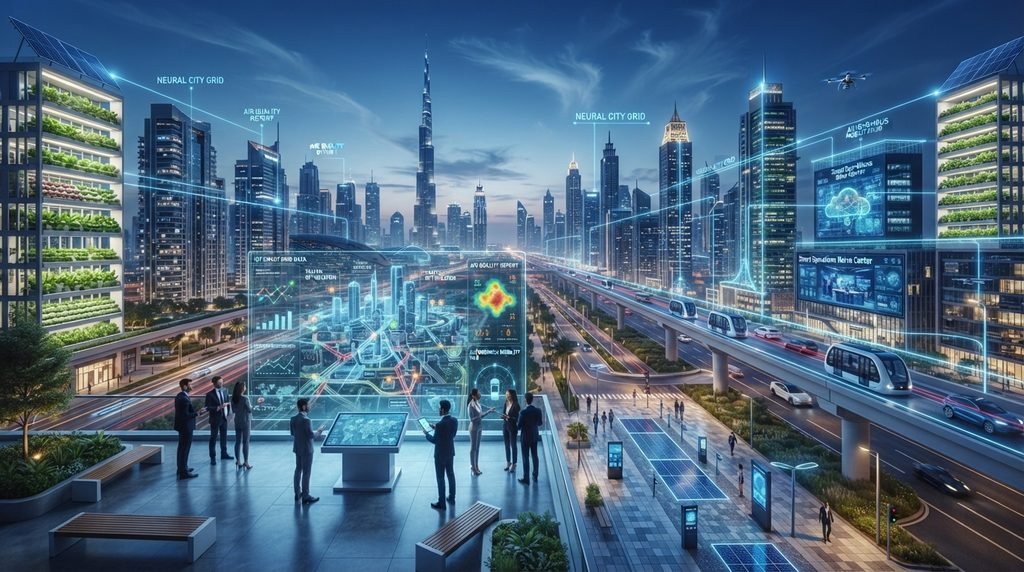
Beyond apps and websites, Dubai is changing its physical spaces. Sensors, networks, and software now run quietly behind roads, buildings, and utilities.
Intelligent Transportation Systems
Transport is a clear example of digital transformation in Dubai. The Dubai Autonomous Transportation Strategy aims for 25 percent of all trips in the emirate to be driverless by 2030. The Metro already runs without drivers, and the Roads and Transport Authority (RTA) has been testing robotaxis with global partners and planning for air taxis.
Nol cards and the Nol Pay app also let commuters use one payment method across metro, bus, tram, and water transport.
Smart Traffic Management
Dubai uses sensors, cameras, and software to watch traffic in real time and adjust signals when roads get busy. Drivers get live updates through navigation apps, and smart parking tools help them find open spaces faster.
Better traffic flow saves time and fuel. It also cuts emissions, which supports the city’s climate goals.
Connected Public Services
Connected services mean one department’s data can reach another when needed. If you move to a new home, for example, your address change can pass between agencies without you filling out the same form again.
Smart kiosks, mobile apps, and shared data platforms make this possible. The result is a city that feels like one service instead of many separate offices.
Sustainable Urban Development
Dubai links technology with its green goals. The Dubai Clean Energy Strategy 2050 aims for 100 percent clean energy by 2050, and the Mohammed bin Rashid Al Maktoum Solar Park is one of the largest solar projects in the world. The Dubai 2040 Urban Master Plan promotes a “20-minute city” idea, where people can reach daily needs within a short walk, ride, or bus trip.
Smart meters and data tools help DEWA and customers track energy use and cut waste.
IoT-Based Infrastructure
IoT sensors now watch water pipes, power networks, streetlights, and building systems. If a pipe leaks or a machine runs hot, the system sends an alert so a team can act early.
Smart buildings use the same idea to adjust cooling and lighting based on how many people are inside. In a hot climate like Dubai’s, those savings add up fast.
Benefits of Digital Transformation in Dubai
The benefits reach residents, companies, and the government itself. Some are easy to count, and others show up in how people feel about the city.
Increased Productivity
Less paperwork means more time for real work. The paperless program saved over 14 million working hours across government. The D33 agenda goes further and aims to raise the productivity of Dubai’s economy by 50 percent through digital innovation.
For a business, productivity gains show up as fewer manual steps, fewer errors, and faster reports.
Faster Service Delivery
Services that took days now take hours or minutes. Online licences, digital payments, and automatic checks between departments remove long waits. A resident can finish many tasks from a phone at night without taking time off work.
Speed matters even more for businesses, where a delayed permit can mean lost sales.
Improved Customer Satisfaction
People are happier when services are simple, clear, and always available. Digital channels also give organizations feedback right away. A rating after a transaction shows what works and what needs fixing.
This was a core aim of Smart Dubai from the start, which focused on the happiness of residents and visitors.
Enhanced Transparency
Digital records show who did what and when. Blockchain contracts, online tracking, and open data make it harder for mistakes or unfair practices to go unnoticed. Investors, tenants, and customers can check facts for themselves.
Clear records also build trust, which is a big reason foreign companies choose Dubai as a base.
Economic Growth and Innovation
Digital projects are expected to add AED 100 billion a year to Dubai’s economy under D33. A report from the Dubai Chamber of Digital Economy projects that the national digital economy could grow from about USD 38 billion to USD 140 billion by 2031.
Growth like this draws startups, investors, and skilled workers, which feeds more innovation.
Challenges of Digital Transformation
The progress is real, but it is not easy or risk-free. McKinsey research has found that only about 30 percent of digital transformations meet their goals, so planning matters.
Cybersecurity Risks
More connected systems mean more targets for attackers. Phishing emails, ransomware, and stolen passwords are common threats. IBM’s 2024 report put the global average cost of a data breach at about USD 4.88 million.
For companies, the lesson is simple. Security cannot be an add-on at the end. It has to be part of the plan from the first day.
Data Privacy Concerns
People share more personal data than ever, from Emirates ID details to health records. They want to know who can see it and how it is used. Rules help, but companies also need clear habits, such as collecting only what they need and explaining why.
Legacy System Integration
Many older organizations still run old software that does not talk to new tools. Connecting the two can be slow and costly. Some companies replace systems step by step, and others add a connecting layer on top of the old one.
A full rebuild is rarely the best first move. Starting with one high-value process often works better.
Digital Skills Gap
Technology only works when people know how to use it. Dubai needs more workers skilled in AI, data, cloud, and cybersecurity. The new AI school curriculum, the Dubai AI Campus, and company training programs all aim to close the gap.
This also changes careers. Even roles in public service now ask for digital skills, which is worth noting if you are exploring government jobs in Dubai.
Change Management and Adoption
People often resist new tools, especially when they have used the old method for years. Fear of job loss, lack of training, and poor communication slow things down.
Leaders who explain the reason for the change, train their teams, and listen to feedback see better results than those who simply announce a new system.
Cybersecurity and Data Protection in Dubai’s Digital Era
Safe systems are the base that everything else stands on. Dubai has built rules and agencies to protect its digital growth.
Importance of Cybersecurity
If people do not trust digital services, they will not use them. Dubai launched its Cyber Security Strategy in 2017, and the Dubai Electronic Security Center (DESC) sets security standards for government entities and monitors threats.
Strong security protects money, privacy, and the city’s reputation as a safe place to do business.
Data Governance Frameworks
Several laws guide how data is handled. The Dubai Data Law of 2015 sets how government data is shared. The UAE Personal Data Protection Law (Federal Decree-Law No. 45 of 2021) covers personal data across the country. DIFC has its own Data Protection Law (Law No. 5 of 2020) for companies in the financial center.
Which rules apply depends on where your company operates and what data it holds, so check with a legal adviser.
Business Best Practices
A few habits stop most common attacks:
- Turn on multi-factor authentication for all staff accounts
- Update software and devices on a fixed schedule
- Back up data often and test that the backups work
- Train staff to spot fake emails and links
- Check the security of vendors and cloud providers
- Keep a written plan for what to do if a breach happens
Protecting Customer Information
Collect only the data you need, store it in encrypted form, and limit who can open it. Tell customers what you collect and why. Delete data you no longer need. If a breach happens, report it quickly to the right authority and to the people affected.
Customers remember how a company handles their information, so this habit builds loyalty as well as safety.
How Businesses Can Start Their Digital Transformation Journey
You do not need a giant budget to begin. You need a clear order of steps. Our roundup of Dubai tech stories can also give you ideas from companies already on this path.
Assess Current Digital Maturity
Start by listing the tools you use now and how well they work. Ask where staff lose time, where customers get stuck, and where data lives. A short audit of systems, skills, and processes shows your starting point.
Define Clear Business Objectives
Pick goals you can measure. “Cut invoice processing from five days to one” is better than “become more digital.” Tie each goal to money, time, or customer satisfaction so everyone knows what success looks like.
Choose the Right Technologies
Match the tool to the problem. A small shop may only need online payments and a customer messaging app. A larger firm may need cloud software, data dashboards, or AI assistants. Test a few options with a small group before you buy for everyone. Our guide to the best AI tools for UAE businesses is a good place to compare choices.
Develop a Digital Strategy
Write a simple plan with steps, owners, a budget, and a timeline. Start with one or two projects that bring quick wins, then build on them. Include training, because a tool nobody can use will not help.
Check that your plan follows the data and security rules that apply to your business.
Measure Performance and ROI
Track numbers from the start. A basic formula for return on investment is the gain minus the cost, divided by the cost. If you spend AED 100,000 on a new system and save AED 150,000 in a year, your return is 50 percent.
Also track softer signals, like customer ratings and staff feedback. Review results every few months and adjust.
Future Trends in Digital Transformation in Dubai
The next stage of digital transformation in Dubai will lean on smarter software, faster networks, and cleaner cities.
Generative AI Adoption
Generative AI can write text, summarize documents, create images, and answer questions in plain language. Dubai’s AI blueprint and the Dubai AI Campus push for wider use in government and business. Expect more tools that draft reports, translate messages, and help staff search large sets of records.
Smart Mobility Solutions
Robotaxis, driverless shuttles, delivery robots, and air taxis are moving from pilots toward real service. The goal of 25 percent driverless trips by 2030 gives these projects a clear target.
5G and Advanced Connectivity
Fast, low-delay networks make many smart city tools work better. 5G supports real-time video, connected vehicles, and large numbers of sensors. UAE operators have been expanding 5G coverage, and the next step is wider use in factories, ports, and hospitals.
Blockchain Applications
Blockchain is moving from pilots to everyday use in property records, identity, and payments. Reports from September 2026 said the UAE plans to bring blockchain technology to the UAE PASS Digital Vault. Details and timing are still limited, so it is best to treat this as an early plan.
Digital Twin Technology
A digital twin is a live virtual copy of a building, road, or whole city. Planners can test changes, such as a new road or a heavy rainstorm, on the copy before spending money in the real world. Dubai has been building detailed 3D city models, which creates a base for this kind of planning.
Sustainable Smart Cities
Expect digital tools to be tied more closely to climate goals. Smart grids, efficient buildings, electric transport, and data tracking will help Dubai move toward its clean energy target for 2050.
Why Digital Transformation Matters for Dubai’s Vision 2030 and Beyond
Dubai’s long-term goals, including its 2030 targets and the D33 agenda, depend on digital progress. To see how these plans connect, our guide to Dubai’s future technology and innovation gives more detail.
Economic Diversification
Oil makes up only a small share of Dubai’s economy today, and the city wants to keep it that way. Digital services, fintech, logistics, and AI add new income streams, so the economy relies less on any single industry.
Global Competitiveness
D33 aims to place Dubai among the top three global urban economies. Fast digital services, a trusted legal setup, and strong connections help the city compete for companies and talent. The agenda also targets about AED 650 billion in foreign direct investment over the next decade.
Innovation-Driven Growth
Startups, labs, and free zones give new ideas a place to grow. When the government tests ideas with young companies, as the Dubai Future Accelerators do, good products reach the market faster, and the city gets better services.
Creating a Knowledge-Based Economy
A knowledge-based economy depends on skilled people more than on natural resources. Dubai invests in schools, AI training, research campuses, and visas that attract talent. The result is a city where ideas, not just buildings, create value.
Conclusion
Dubai has moved from big plans to real results. The paperless government saved more than AED 1.3 billion, UAE PASS serves over 12 million users, and smart transport, AI tools, and online services now shape daily life. Digital transformation in Dubai is no longer a future idea. It is the way the city works today.
The opportunities are wide. Businesses can cut costs, reach more customers, and use data to make better choices. Individuals can learn digital skills, work remotely, or build a company with fewer barriers than before.
Looking ahead, Dubai is aiming to be a global technology hub, with AI, 5G, blockchain, and digital twins pushing the next stage. The challenges, such as cybersecurity and the skills gap, are real, but the city has shown it can plan around them.
The best way to adapt is to start small, pick a clear goal, protect your data, and keep learning. Those who build digital habits now will be ready for what the city builds next.
Frequently Asked Questions (FAQs)
What is digital transformation in Dubai?
Digital transformation in Dubai is the citywide effort to use technology, such as AI, cloud, IoT, and blockchain, to change how government and businesses work. It covers online public services, smart transport, digital identity through UAE PASS, and new business models. The goal is faster service, lower cost, and stronger economic growth under the D33 agenda.
Why is Dubai considered a leader in digital innovation?
Dubai combines clear leadership, large investment, and flexible rules. It launched the Smart Dubai initiative in 2014, became the first fully paperless government, runs driverless transport, and offers free zones and visas that attract tech talent. D33 sets a clear target of AED 100 billion a year from digital projects.
How does digital transformation benefit businesses in Dubai?
It helps businesses save time and money, serve customers faster, and make better choices with data. Online licences and digital payments reduce paperwork. Automation lowers manual errors, and e-commerce and apps reach more buyers. Businesses can also hire remote talent and use public data to plan growth.
What technologies are driving Dubai’s digital economy?
The main ones are artificial intelligence, cloud computing, big data analytics, the Internet of Things, blockchain, and automation and robotics. Fast 5G networks and digital identity tools such as UAE PASS support them. Together they power smart transport, online government services, and new business models.
How is AI contributing to Dubai’s transformation?
AI powers chatbots, traffic tools, fraud detection, demand forecasting, and predictive maintenance. The Dubai Universal Blueprint for Artificial Intelligence aims to help add AED 100 billion to the economy and raise productivity by 50 percent. AI is also being added to school lessons and training programs to build future skills.
What challenges do organizations face during digital transformation?
The most common ones are cybersecurity threats, data privacy worries, old systems that do not connect with new tools, a shortage of digital skills, and staff resistance to change. McKinsey research suggests only about 30 percent of transformations reach their goals, so clear planning, training, and security matter.
How can small businesses embrace digital transformation in Dubai?
Start small. Move payments, bookings, and customer chats online first. Use affordable cloud tools for accounting and inventory, and try one AI assistant for support or content. Set a simple goal, train your team, protect customer data, and track results every few months before you add more tools.

Ahmad Yusuf is a professional content writer with experience creating engaging, well-researched content across lifestyle, travel, and business topics. With a strong understanding of Dubai’s dynamic culture and experiences, he currently writes for Dubai Unfold, covering the city’s attractions, lifestyle, events, and evolving trends. His work combines clear storytelling with accurate information to help readers discover and experience Dubai.