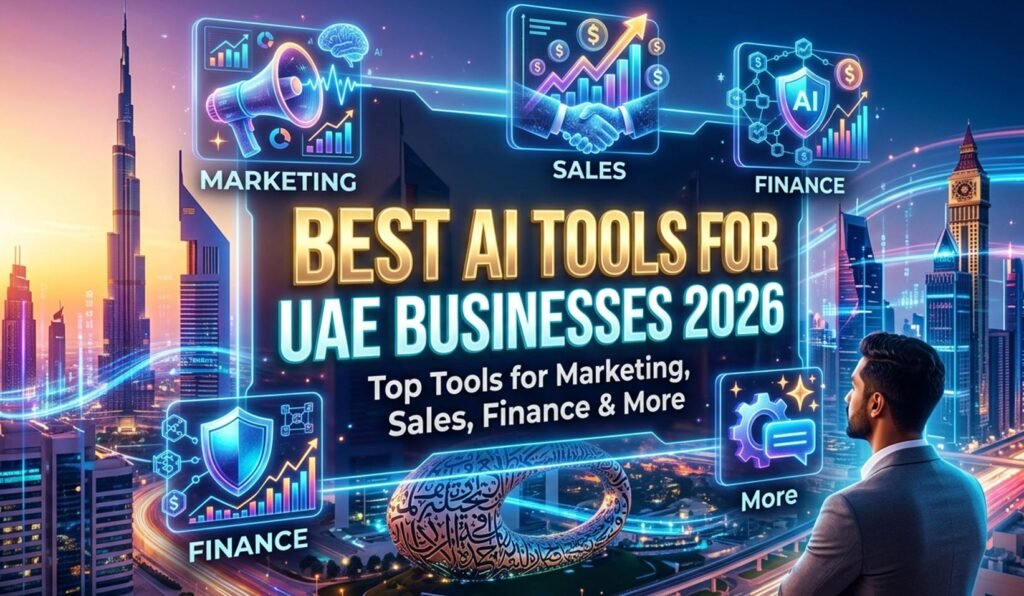
If you run a business in the UAE, you have probably felt the pressure to do something with AI but weren’t sure where to start. That’s fair. The market is loud, every app claims to be AI powered, and picking the wrong tool wastes both money and time. This guide cuts through the noise and walks you through the best AI tools for UAE businesses, based on what actually works for companies operating here, not generic global advice copied from a US blog.
The UAE isn’t just dabbling in AI. The UAE’s digital economy strategy seeks to double the contribution of the digital economy to non-oil GDP by 2031, and PwC estimates artificial intelligence alone could contribute nearly $96 billion to the UAE economy by 2030, close to 14% of GDP. Dubai has its own push too, with a target to attract 10,000 AI firms by 2030 as part of its plan to stay ahead as a tech hub. This isn’t background noise. It’s the reason so many SMEs, startups, and large companies across the country are now adopting AI tools to cut costs, save time, and stay competitive.
Understanding the UAE Business Landscape
Before picking any tool, it helps to understand what makes the UAE market different from everywhere else.
Industries Leading the Adoption
Retail, logistics, finance, hospitality, and healthcare are moving fastest. Retailers use AI to predict what sells during Ramadan or the cooler tourist season. Logistics companies use it to plan delivery routes around Dubai’s traffic patterns. Banks use it to catch fraud in real time. Hotels use it to personalize guest experiences for visitors from dozens of different countries. Healthcare providers use it to speed up diagnosis and manage patient records more accurately.
What Makes the UAE Different
Three things set this market apart. First, customers switch between Arabic and English constantly, sometimes in the same conversation, so tools need to handle both smoothly. Second, the market moves fast. New competitors, new malls, new e-commerce platforms, and new regulations show up quickly, so businesses need tools that adapt just as fast. Third, competition is intense, especially in Dubai and Abu Dhabi, where dozens of businesses fight for the same customer segments.
SMEs vs Large Enterprises
Large enterprises usually have the budget and in-house teams to build custom AI systems. SMEs don’t have that luxury. Most small and mid-sized UAE businesses need tools that are affordable, quick to set up, and don’t require a data science team to run. That’s exactly the gap this guide focuses on filling.
Criteria for Choosing AI Tools in the UAE
Not every AI tool that works well in the US or Europe will work well here. Before you commit to a subscription, check it against these points.
Arabic and English Language Support
Your tool should handle both languages without sounding robotic in Arabic. A chatbot that only works in English will frustrate a big part of your customer base.
Compliance With UAE Data Regulations
Make sure the tool follows UAE data protection rules, especially if you’re in finance, healthcare, or government-adjacent work. Some tools offer regional data hosting, which is worth asking about directly.
Scalability
Your business today might look very different in eighteen months. Pick tools that can grow with you instead of ones you’ll outgrow in a year.
Integration With Local Platforms
Check whether the tool connects easily with what you already use, whether that’s Zoho, HubSpot, Shopify, Noon, or Amazon.ae. A tool that can’t talk to your existing systems creates more work, not less.
Cost Efficiency for SMEs
Many AI tools price for enterprise budgets. Look for flexible plans, free trials, and pay-as-you-go options if you’re a smaller business testing the waters.
Best AI Tools for Marketing and Sales in UAE
Marketing is usually where UAE businesses see the fastest return from AI, since it directly touches revenue.
AI Marketing Platforms
Tools like HubSpot AI and Salesforce Einstein help automate campaigns, personalize content for different customer segments, and target ads more precisely. For UAE businesses running campaigns across Dubai, Abu Dhabi, and Sharjah at the same time, this kind of automation saves hours every week.
Chatbots and Conversational AI
Platforms like Tidio, Intercom, and locally built solutions handle customer questions around the clock. Given how many UAE customers browse and shop late at night or across time zones while traveling, a bilingual chatbot can catch sales that would otherwise be lost.
AI CRM Enhancers
Tools that plug into your CRM, such as Zoho’s AI assistant Zia or HubSpot’s AI scoring features, help you figure out which leads are actually worth chasing. Instead of your sales team guessing, the software ranks leads based on real behavior.
Arabic Content Generation
Writing natural, culturally accurate Arabic content used to require a dedicated copywriter. Tools built for Arabic generation now handle first drafts of social posts, product descriptions, and ad copy, which your team can then polish.
Best AI Tools for Operations and Productivity
Behind every successful UAE business is a set of daily operations that either run smoothly or drain everyone’s time.
Workflow Automation Tools
Zapier and Make (formerly Integromat) connect your apps so tasks move automatically between them. For example, a new Shopify order can automatically trigger an invoice, update your inventory, and notify your delivery partner, all without anyone touching a spreadsheet.
AI Assistants for SMEs
Tools like Notion AI and Microsoft Copilot help small teams manage scheduling, draft reports, and organize projects without hiring extra admin staff. This matters a lot for UAE startups running lean teams.
AI Document Processing
Contract review, invoice processing, and compliance paperwork eat up hours every month. Tools like DocuSign’s AI features and ABBYY FlexiCapture pull out key data from documents automatically, cutting manual entry significantly.
Compatibility With Government Portals
Some UAE businesses now use AI-assisted tools that help prepare documentation for government portals like the Ministry of Human Resources and Emiratisation or Dubai’s DED services, reducing back-and-forth errors during submissions.
Best AI Tools for Finance and Accounting
Money matters need accuracy, and this is one area where AI genuinely reduces costly mistakes.
AI Accounting Software for SMEs
Zoho Books and QuickBooks now come with AI features that categorize expenses, flag unusual transactions, and generate financial reports automatically. This is especially useful for SMEs without a full finance department.
AI Fraud Detection Tools
For fintech startups and e-commerce businesses processing high transaction volumes, tools like Sift and Feedzai flag suspicious activity in real time, which matters a lot given how fast online fraud tactics evolve.
AI Expense Management
Corporate structures in the UAE, especially those with multiple entities or free zone setups, benefit from tools like Expensify’s AI receipt scanning, which speeds up reimbursement and keeps records audit-ready.
VAT-Compliant AI Tools
Since UAE VAT rules require accurate record keeping, accounting tools with built-in VAT calculation and reporting features, such as Zoho Books’ UAE-specific VAT module, save businesses from manual errors that can lead to penalties.
Best AI Tools for E-commerce and Retail
E-commerce in the UAE is booming, and AI tools are a major reason some sellers pull ahead of the pack.
AI Product Recommendation Engines
Tools like Nosto and Dynamic Yield analyze browsing behavior to show shoppers products they’re actually likely to buy, which increases average order value without extra ad spend.
AI Inventory and Demand Forecasting
Retailers use tools like Blue Yonder and Netstock to predict demand spikes, such as before Ramadan, Eid, or big sale events like the Dubai Shopping Festival, so they don’t run out of stock or overorder.
AI Pricing Optimization
Dynamic pricing tools adjust prices based on demand, competitor pricing, and stock levels in real time. This is especially useful for sellers competing on Noon and Amazon.ae, where prices shift constantly.
Platform Integrations
The most useful e-commerce AI tools plug directly into Shopify, WooCommerce, Noon, and Amazon.ae, so you’re not manually syncing data between systems every day.

Best AI Tools for HR and Recruitment
Hiring in the UAE’s competitive job market takes time, and AI tools help HR teams move faster without lowering quality.
AI Resume Screening
Tools like HireVue and Zoho Recruit’s AI screening features scan hundreds of applications and shortlist candidates based on skills and experience, saving recruiters days of manual review.
AI Skill Assessment Platforms
Platforms like HackerRank and TestGorilla let employers test candidates on real skills before an interview, which is especially useful in tech and finance roles where the wrong hire is costly.
AI Employee Productivity Monitoring
Tools like ActivTrak give managers visibility into how work actually flows across remote and hybrid teams, which many UAE businesses have adopted since the shift toward flexible work arrangements.
Labor Law Compliance Support
Some HR platforms now include features that help track UAE labor law requirements, such as leave entitlements, end-of-service calculations, and visa renewal reminders, reducing the chance of compliance slip-ups.
Best AI Tools for Cybersecurity
As UAE businesses digitize faster, they also become bigger targets. Cybersecurity tools with AI built in catch threats that older systems miss.
AI Threat Detection Systems
Tools like Darktrace and CrowdStrike use machine learning to spot unusual network activity before it turns into a full breach, which matters given how quickly attack methods evolve.
AI Email Security Tools
Phishing remains one of the most common attack methods. Tools like Proofpoint and Mimecast use AI to catch suspicious emails that traditional spam filters miss.
AI Identity and Access Management
Platforms like Okta help control who can access what within your systems, using behavioral analysis to flag logins that look out of place.
Meeting UAE Cybersecurity Standards
Businesses handling sensitive data, particularly in finance and government-adjacent sectors, should check that their security tools align with UAE Information Assurance regulations and the requirements set by the Telecommunications and Digital Government Regulatory Authority.
Best AI Tools for Customer Experience
Customer experience is where UAE businesses can really stand out, given how much competition exists across every sector.
AI Sentiment Analysis Tools
Tools like MonkeyLearn and Brandwatch scan reviews, social mentions, and support tickets to tell you how customers actually feel, not just what they say in surveys.
AI Voice Assistants
Bilingual voice assistants that handle both Arabic and English are becoming common in call centers and hospitality settings, cutting wait times for customers who’d rather speak than type.
AI Feedback and Survey Automation
Platforms like Qualtrics use AI to analyze open-ended survey responses at scale, picking out patterns a human team would take weeks to spot manually.
Sector-Specific Applications
Hospitality brands use these tools to personalize guest stays. Retailers use them to fine-tune in-store and online experiences. Service businesses use them to catch complaints early, before they turn into public reviews.
Industry-Specific AI Tools in UAE
Some sectors need tools built specifically for how they operate.
AI for Real Estate
Property platforms use AI for automated valuations and lead scoring, helping agents in Dubai’s fast-moving property market prioritize serious buyers over casual browsers.
AI for Healthcare
AI-assisted diagnostics and patient management systems are gaining ground in UAE hospitals and clinics, helping doctors process scans and manage patient records more efficiently. Healthcare is one of the priority sectors in the UAE’s national AI strategy, so expect more investment here over the coming years.
AI for Logistics
Route optimization and fleet management tools help logistics companies cut fuel costs and delivery times, which matters a lot given Dubai and Abu Dhabi’s traffic patterns and the region’s fast-growing e-commerce delivery demand.
AI for Restaurants
UAE restaurants use AI for menu engineering, figuring out which dishes are actually profitable, and for demand forecasting, so kitchens can prep the right amount of food and cut waste.
Cost Breakdown: AI Tools for UAE SMEs vs Enterprises
Budget is usually the first question business owners ask, so here’s a realistic breakdown.
Typical Pricing Ranges
Basic AI tools for SMEs, like chatbots or simple automation platforms, often start around AED 100 to AED 500 per month. Mid-tier tools with more advanced features, such as CRM AI add-ons or inventory forecasting, typically run AED 1,000 to AED 5,000 monthly. Enterprise-grade AI systems, especially custom-built solutions, can run into tens of thousands of dirhams monthly depending on scale.
Subscription vs Pay-As-You-Go
Subscription models work well for tools you’ll use constantly, like a CRM or accounting platform. Pay-as-you-go models suit businesses testing a tool or using it occasionally, such as document processing during tax season.
Budget Planning for Small Businesses
Start with one or two tools that solve your biggest pain point, whether that’s customer response time or inventory guesswork. Prove the value before expanding into a full AI stack. Trying to adopt everything at once usually leads to wasted subscriptions nobody actually uses.
Implementation Roadmap for UAE Businesses
Buying a tool is the easy part. Making it actually work inside your business takes a plan.
Step-by-Step Adoption Plan
Start by identifying your biggest time drain or cost problem. Pick one tool that directly addresses it. Run a trial period with a small team before rolling it out company-wide. Then expand gradually, adding tools only once the last one is fully adopted.
Training Your Team
Even the best AI tool fails if your team doesn’t know how to use it. Set aside time for short training sessions, and assign one person per team to be the go-to expert for that tool.
Measuring ROI
Track specific numbers before and after adoption, whether that’s response time, cost per lead, or hours saved per week. Without this data, you won’t know if the tool is actually paying for itself.
Common Mistakes to Avoid
The most common mistake is buying too many tools at once without a clear plan. Another is skipping staff training and assuming the software is self-explanatory. A third is ignoring data privacy settings, which can create compliance headaches later.
Future of AI in UAE
Government Initiatives Driving Growth
The UAE aims to become one of the leading nations in AI by 2031, generating up to AED 335 billion in additional economic growth as part of its national strategy. On top of that, Dubai’s AI economic strategy targets adding AED 100 billion through digital transformation and increasing economic productivity by 50 percent as part of the Dubai Economic Agenda D33. These aren’t just announcements. They translate into real funding, incubators, and incentives that UAE businesses can tap into. uarab
Trends to Expect Through 2030
Expect deeper AI integration in government services, more Arabic-first AI tools built specifically for the region, and growing investment in AI-powered data centers. The Oxford Insights Government AI Readiness Index already ranks the UAE first in the Arab world and among the top 15 globally, so the pace of adoption is unlikely to slow down.
How to Stay Ahead
Keep an eye on new government-backed AI programs, since many come with grants or free training for SMEs. Build a habit of reviewing your AI stack every six months, since new and better tools launch constantly. Most importantly, treat AI as a long-term investment, not a one-time purchase.
Conclusion
Choosing the best AI tools for UAE businesses isn’t about grabbing whatever is trending. It’s about matching the right tool to your specific pain point, whether that’s slow customer response times, manual accounting work, or guessing at inventory needs. The businesses that win with AI in this market are the ones that start small, measure results, and expand only once a tool proves its worth.
Given the scale of investment behind the UAE’s AI ambitions, waiting on the sidelines is the riskier move. Start with one tool this month. Pick the pain point that costs you the most time or money, test a solution built for the UAE market, and build from there.