
A Dubai tourist visa is a short-stay entry permit that lets you visit Dubai for holidays, family visits, shopping or sightseeing. You cannot work on it. Most people get one for 30 or 60 days, and frequent travelers can choose a five-year multiple entry option.
Not everyone needs to apply. Citizens of the Gulf Cooperation Council (GCC) countries can enter without a visa. Passport holders from about 70 countries get free entry on arrival, and everyone else has to arrange a visa before flying.
This Dubai tourist visa guide explains who needs a visa, which type fits your plan, what documents to prepare, how much it costs and how long it takes. Small mistakes like a wrong passport number or a late exit can cost you money and ruin a trip. Learning the rules first saves you from that.
Quick overview of your Tourist visa options:
- Visa-free or free entry on arrival: for eligible nationalities, 30 or 90 days
- Conditional visa on arrival: 14 or 60 days for a few nationalities with foreign residence permits
- 30-day or 60-day tourist visa: single or multiple entry, applied for before travel
- Five-year multiple entry tourist visa: for frequent visitors, no sponsor needed
What Is a Dubai Tourist Visa?
A Dubai tourist visa is an official permit issued by UAE immigration authorities that allows a foreign visitor to enter Dubai and stay for a set number of days for leisure purposes.
Definition and Purpose
The permit is issued through the Federal Authority for Identity, Citizenship, Customs and Port Security (ICP) or the General Directorate of Residency and Foreigners Affairs in Dubai (GDRFA). Its purpose is simple: to allow short, temporary visits for tourism without giving you any right to live or work in the country.
Difference Between a Tourist Visa and a Visit Visa
People use these two terms as if they mean the same thing, and in daily life they mostly do. A visit visa is the wider category. It covers tourism, family visits and short business trips. A tourist visa is the leisure-focused type, and it is often sponsored by an airline, hotel or travel agency. The five-year option is officially listed as a multiple entry tourist visa, but it also works for family and business visits.
Who Can Apply
Almost anyone with a valid passport can apply, as long as their country is not blocked from UAE entry. Children can apply too. If you already qualify for free entry on arrival, you do not need to apply at all.
What You Can Do on a Tourist Visa
- Visit attractions, beaches, malls and desert camps
- Stay with family or friends, or in a hotel
- Attend events or festivals as a visitor
- Take part in short leisure activities such as tours and dining
What You Cannot Do on a Tourist Visa
- Take a job, paid or unpaid, with a UAE employer
- Run a business or freelance for local clients
- Stay longer than your permitted days
- Live in Dubai on it for the long term
If you are thinking about moving, read our Dubai travel guide section for the right residency routes.
Who Needs a Tourist Visa for Dubai?
It depends on your passport. Dubai sorts travelers into four groups.
Nationalities Eligible for Visa-Free Entry
Passport holders from 49 countries, including the United States, the United Kingdom, Canada, Australia, Japan and most of Europe, can stay up to 90 days. The 90 days are counted inside any 180-day period, and multiple entries are allowed. Another group of about 13 countries gets 30 days, and in many cases this can be extended by 30 more days.
This entry is free, but you cannot work on it. Because lists change, check your own country on the ICP website before booking.
Countries Eligible for Visa on Arrival
In 2026 the UAE widened a conditional visa on arrival to seven nationalities: India, Indonesia, Kenya, the Philippines, South Africa, Thailand and Vietnam. You must hold a valid residence permit from the US, the EU, the UK, Singapore, Japan, South Korea, Australia, New Zealand or Canada. Depending on the category, the stay is 14 or 60 days. Airlines often check these papers at check-in, so carry the originals.
Travelers Who Must Apply Before Arrival
If your passport is not on any of the lists above, you must hold an approved visa before you board. Airlines will refuse boarding without it. Apply at least two weeks before your flight so you have room for delays.
GCC Residents and Special Cases
Citizens of Saudi Arabia, Kuwait, Qatar, Bahrain and Oman can enter with a valid passport or national ID. Foreign residents living in a GCC country can apply for an e-visa. It is valid for 30 days from the issue date and allows a 30-day stay, and the fee is roughly AED 250.
Types of Dubai Tourist Visas
Here is a quick look at each option so you can pick the one that matches your plans. Government fees move up and down by channel, so treat the amounts below as typical ranges, not fixed prices.
30-Day Single Entry Tourist Visa
- Validity: You usually have 60 days from approval to enter, then 30 days to stay. You can enter only once.
- Best suited for: A one-time holiday, a honeymoon or a short family trip.
30-Day Multiple Entry Tourist Visa
- Benefits: You can leave and come back within the validity period, so side trips to Oman or Abu Dhabi do not use up your visa.
- Common use cases: Travelers who split their trip with a short visit to another country, or business visitors who go back and forth.
60-Day Single Entry Tourist Visa
- Validity period: 60 days of stay after entry, one entry only.
- Suitable travelers: Visitors who want a long vacation, people staying with relatives, or anyone who wants a buffer in case plans change.
60-Day Multiple Entry Tourist Visa
- Advantages for frequent visitors: More days and more freedom. The cost per day of stay is often lower than for the 30-day option, which makes it useful for people who travel in and out of the UAE.
Five-Year Multiple Entry Tourist Visa
- Eligibility criteria: It is open to all nationalities. You need proof of at least USD 4,000, or the equivalent, in your bank account during the last six months, a return ticket and valid health insurance.
- Key benefits: No sponsor or host needed. You can stay up to 90 days per visit, extendable by another 90, with a yearly cap of 180 days. Processing is often around 48 hours.
- Travel limitations: You must enter within 60 days of approval. The stay is counted from your first entry date, not the calendar year. Unused days do not carry over.
Dubai Tourist Visa Requirements
Required Documents
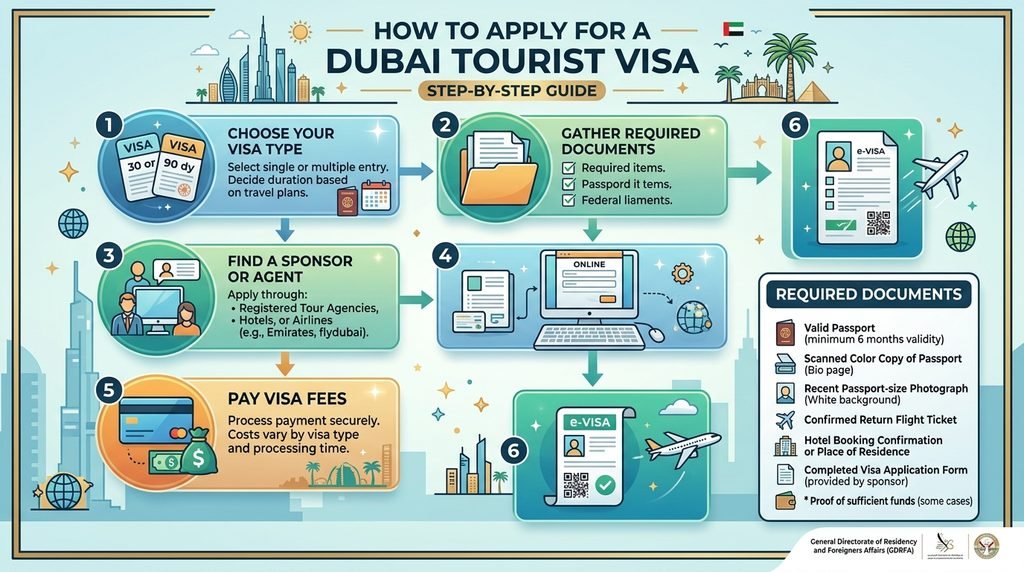
- Passport: Valid for at least six months from your arrival date, with blank pages. Scan the first page in color.
- Passport photographs: A recent color photo with a white background, taken facing the camera with no glasses or heavy filters.
- Application form: Fully filled with the same spelling as your passport.
- Travel itinerary: A basic plan showing your dates and places.
- Accommodation proof: A hotel booking, or an invitation letter with your host’s Emirates ID if staying with family.
- Return or onward ticket: A confirmed booking out of the UAE.
Financial Requirements
Most 30-day and 60-day applicants do not have to show bank statements. Some agents or airlines may ask for them, especially from certain nationalities, so keep your last three months of statements handy. The five-year visa is the exception. It needs six months of attested bank statements with at least USD 4,000 in your account the whole time, and a refundable guarantee deposit of around AED 3,000 is also reported.
Additional Requirements for Minors
- A signed consent letter from both parents, or from the parent who is not traveling
- Copy of the child’s passport and birth certificate
- Copies of the parents’ passports
- If the child travels alone, details of the adult receiving them in Dubai
How to Apply for a Dubai Tourist Visa
Applying Through Airlines
Emirates, Etihad and flydubai all help passengers with visas when they buy a ticket. You send your documents, they process them with the authorities and you get the visa by email. It is simple and safe, but airlines usually charge a service fee and may only help customers flying with them.
Applying Through Travel Agencies
Agencies handle the paperwork, which is a big help if you are new to this. The downsides are higher service fees and less control over timing. Make sure the agency is licensed, and always ask for the visa copy in writing.
Applying Through Hotels or Sponsors
A UAE hotel, tour operator or resident host can sponsor you. This is common for 30-day and 60-day visas. A sponsor is needed when you are not using the five-year visa or applying through an airline, and the sponsor takes responsibility for your stay.
Applying Through Official UAE Channels
You can apply yourself through the ICP Smart Services portal, the ICP UAE app or the GDRFA Dubai website and app. This is the cheapest and most transparent way, since you pay only the government fee. Beware of copycat websites. Always type the official address yourself.
Step-by-Step Application Process
- Choose your visa type. Match the days and entries to your plan.
- Gather your documents. Scan your passport, photo and tickets in clear files.
- Submit your application. Use the portal, your airline or an agent.
- Pay the fees. Keep the receipt.
- Receive approval. The visa arrives by email as a PDF. Print two copies.
- Travel to Dubai. Enter within the validity window, usually 60 days from approval.
Dubai Tourist Visa Processing Time
Standard Processing
For 30-day and 60-day visas, most approvals come in about three to five working days. The five-year visa is often ready in around 48 hours once everything is complete.
Express Processing
Some agents and airlines offer a rush service that can cut the wait to 24 to 48 hours for an extra fee. It is useful for last-minute trips, though it is not always available.
Factors That May Cause Delays
- Incomplete documents: Missing pages or blurry scans are the most common reasons.
- Public holidays: Eid and National Day slow things down. Apply early in those seasons.
- Additional verification: Some applications get a deeper check, which takes longer.
Dubai Tourist Visa Fees
Factors Affecting Visa Cost
Price depends on the visa length, single or multiple entry, how you apply, your nationality and whether you use express service.
Single Entry vs Multiple Entry Costs
Expect a 30-day single entry visa to cost roughly AED 250 to AED 400, and a 60-day single entry visa a little more. Multiple entry visas cost more, often AED 500 to AED 800 or higher. The five-year visa costs about AED 3,700 in total as reported, with a refundable guarantee included.
Additional Charges and Service Fees
Agencies and airlines add service fees, and 5% VAT applies to those service charges. Status change fees apply if you apply from inside the UAE.
Refund Policy Considerations
Government fees are usually not refundable once the application is submitted, even when the visa is rejected. The five-year visa is an exception, since refunds are allowed in cases of cancellation, expiry or rejection, and the guarantee can be returned if you follow the rules.
Tourist Visa Validity and Stay Duration
Visa Validity Explained
Validity is the time window in which you must enter the UAE. For most 30-day and 60-day visas this is 60 days from the date of issue.
Maximum Stay Allowed
Stay length depends on the visa. A 30-day visa gives 30 days, a 60-day visa gives 60 days, and the five-year visa allows 90 days per visit, up to 180 days in a year.
Difference Between Entry Validity and Stay Period
Think of it like a coupon. Entry validity is the date the coupon expires. Stay period is how long you can use it after you step in. If your visa says you must enter within 60 days and stay 30, your 30 days start the moment you land, not the day the visa was issued.
Consequences of Overstaying
The UAE now charges a flat AED 50 per day for overstaying on all visa types, and the old 10-day grace period no longer exists. You may also face travel bans, extra fees and trouble getting future visas. Always set a reminder for your exit date.
Can You Extend a Dubai Tourist Visa?
Yes, in most cases. This is a short overview. For full details, see our Dubai visa extension guide in the Dubai travel guide section.
Extension Eligibility
Most 30-day and 60-day visas can be extended by 30 days, and some allow a second extension. Apply before your visa expires.
Extension Process
You can request an extension online through the ICP portal, or visit a typing center. No exit and re-entry is needed in most cases.
Required Documents
Passport copy, current visa copy and a return ticket.
Extension Fees
Expect around AED 600 to AED 850, depending on the channel.
Common Reasons for Rejection
Late applications, unpaid fines and a visa type that does not allow extensions.
Reasons a Dubai Tourist Visa Application May Be Rejected
Incorrect Personal Information
A misspelled name or wrong passport number is one of the fastest ways to get rejected. Copy your details straight from the passport.
Passport Issues
Passports with less than six months of validity, damaged pages or poor scans will fail.
Previous Immigration Violations
If you overstayed in the past or have unpaid fines, your new application can be refused.
Duplicate Applications
Submitting twice for the same person, even through two agents, can block both.
Security or Compliance Concerns
Authorities can refuse any applicant for security reasons, and they do not have to give a detailed explanation.
How to Check Dubai Tourist Visa Status
Online Tracking Methods
Use the ICP Smart Services portal, the ICP UAE app or the GDRFA Dubai website. You can also ask your airline or agent.
Information Needed to Track Status
Your passport number, date of birth, nationality and application number or file number.
What Different Status Updates Mean
- Under process: The authorities are still reviewing.
- Approved or issued: Your visa is ready to download.
- Rejected: The application failed, and you will need a new one.
- Expired: The entry window has passed without use.
Entry Requirements Upon Arrival in Dubai
Documents to Present at Immigration
Carry your passport, a printed visa copy, your hotel booking, your return ticket and a local contact number.
Health and Travel Requirements
There are no general vaccine rules for most visitors. A yellow fever certificate may be needed if you are coming from certain countries in Africa or South America. Travel insurance is not required by law for most tourists, but it is smart to have, and the five-year visa needs valid health insurance.
Customs and Immigration Checks
Officers scan your passport, take your fingerprints or a face photo, and may ask short questions about your plans. Do not bring banned items such as certain medicines without a prescription, or drones without approval.
Tips for Smooth Entry
- Keep papers in your hand luggage
- Answer questions simply and truthfully
- Save offline copies of all documents on your phone
Common Tourist Visa Mistakes to Avoid
- Booking non-refundable tickets too early: Wait for visa approval first.
- Applying for the wrong visa type: A single entry visa will not cover a side trip abroad.
- Using expired passport copies: Always scan a fresh copy.
- Entering incorrect passport details: One wrong digit can void the visa.
- Missing visa validity deadlines: Enter before the window closes.
- Ignoring overstay penalties: AED 50 per day adds up fast.
Conclusion
A good Dubai tourist visa guide comes down to a few habits. Choose the visa type that fits your trip, prepare your documents carefully, apply only through authorized channels, follow UAE immigration rules while you are there and plan your travel around your visa dates. Do these five things and your arrival in Dubai will be smooth.
Frequently Asked Questions
How long does a Dubai tourist visa take to be approved?
Most 30-day and 60-day visas take about three to five working days. The five-year visa is often approved in around 48 hours, and express options can be faster.
Can I enter Dubai multiple times on a tourist visa?
Only with a multiple entry visa. The 30-day and 60-day multiple entry options and the five-year visa allow this. A single entry visa lets you enter once.
Can I convert a tourist visa into another visa type?
Often yes. You can change status inside the UAE for visas such as employment or job seeker, but you will pay a status change fee. Some people choose to exit and re-enter instead.
What happens if my tourist visa expires?
You become an overstayer. You will pay AED 50 per day, and there is no grace period. You can also face travel bans and problems with future visas.
Can children apply for a tourist visa?
Yes. Children use the same process as adults, plus a birth certificate and parent consent documents. Families can apply together.
Is travel insurance required?
Not for most 30-day and 60-day visas, but it is strongly advised. The five-year multiple entry visa does require valid health insurance.
Can I work in Dubai with a tourist visa?
No. Working on a tourist visa is illegal, and it can lead to fines and a ban. You need a proper work permit and residency visa.
Can I apply for a tourist visa without a sponsor?
Yes, if you choose the five-year multiple entry visa, which is self-sponsored. For 30-day and 60-day visas you usually apply through an airline, agency or hotel, or you can use the official ICP and GDRFA portals.

Ahmad Yusuf is a professional content writer with experience creating engaging, well-researched content across lifestyle, travel, and business topics. With a strong understanding of Dubai’s dynamic culture and experiences, he currently writes for Dubai Unfold, covering the city’s attractions, lifestyle, events, and evolving trends. His work combines clear storytelling with accurate information to help readers discover and experience Dubai.